

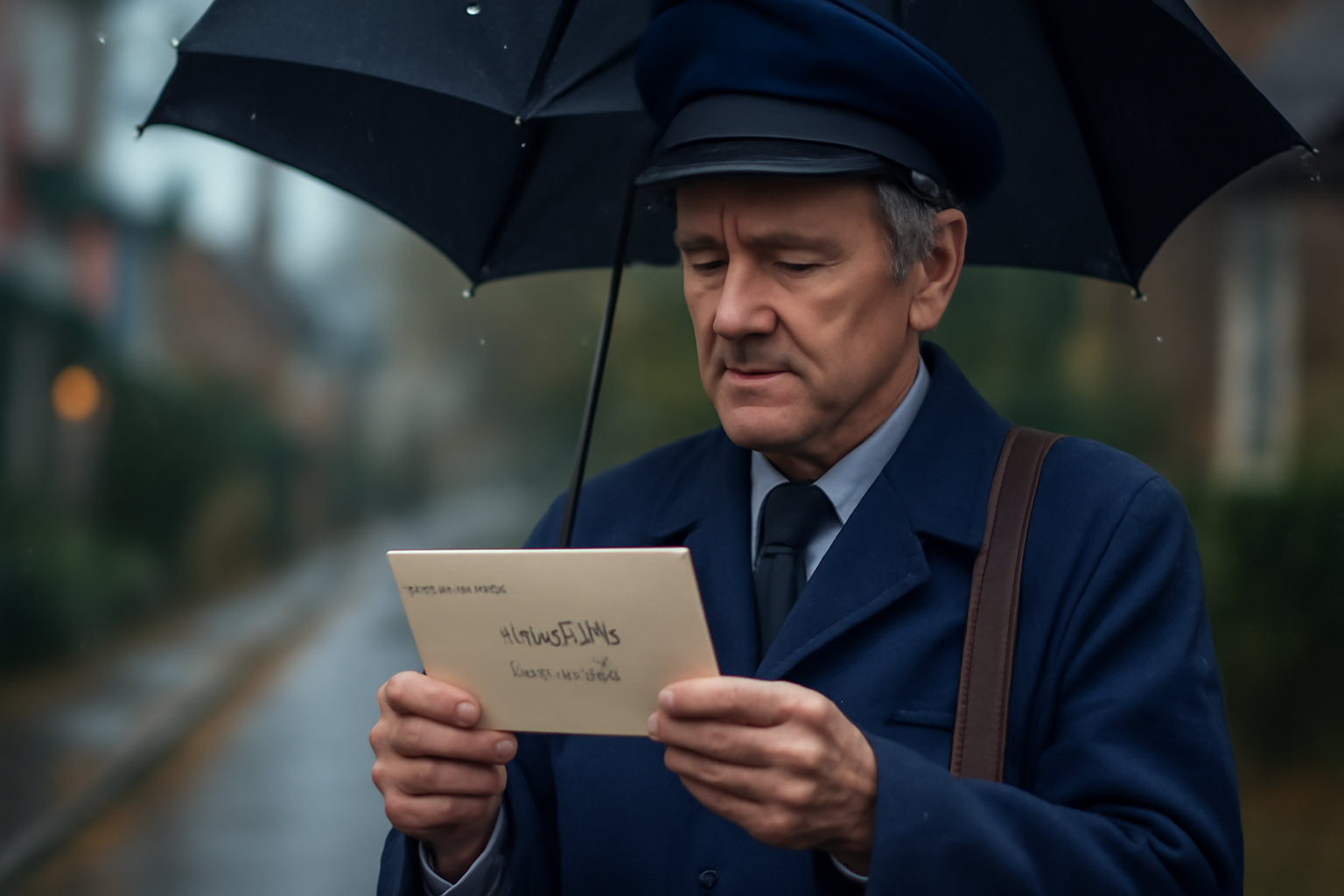
The first time it happened, Arthur thought someone was playing a joke on him.
He’d been a postman for almost thirty years — long enough to know the weight of letters by the bend of the envelope, to recognize half the town’s handwriting at a glance, to tell a birthday card from a bill just by the way the paper sighed in his hands.
His route was a small one. Cozy, really. Willow Row, Bracken Lane, the cottages along the river, the flats above the bakery where the smell of cinnamon liked to flirt with the morning air. People waved at him. Kids used to leave scribbled pictures in their mailboxes “for the mail fairy.” Dogs barked at him out of principle, then wagged their tails when he passed.
Arthur liked the rhythm of his days: walk, sort, deliver, repeat. The world was large and loud and fast, but his route stayed blessedly knowable.
Then one Tuesday in late October, he found a letter that shouldn’t exist.
It was at the bottom of his bag, where the last few envelopes always drifted.
Plain white. Proper stamp. Neat handwriting.
He glanced at the address.
To:
Arthur Ellis
c/o Willow Row Post Depot
Present Day
He frowned.
“Someone’s having a laugh,” he muttered.
The corner of the envelope caught the light. Not in the usual dull way of paper, but with the smallest shimmer, like dew clinging to cobwebs.
Arthur turned it over.
No return address.
Just two words in the same neat hand:
From:
Next Tuesday
He stared at it.
No one could see him — the sorting room was empty, the other carriers already on their routes — so he allowed himself one solid, satisfying eye roll.
“Very funny,” he told the air. “Whoever you are.”
But his fingers were careful when they slit it open.
Inside was a single sheet of paper.
The letter was short.
Arthur,
You’re going to forget your umbrella today. Take it. It’ll rain at 3:17. You’ll offer it to the woman at number 12 Bracken Lane. She’ll remember that someone was kind, and a week from now that memory will keep her from doing something she can’t undo.
You won’t know that part. You don’t need to.
Just take the umbrella.
Also: drink the peppermint tea Sharon put in your cupboard last Christmas. It actually helps the heartburn.
With fondness,
Arthur (slightly older, not much wiser)
P.S. You’ll doubt this. That’s all right. Take the umbrella anyway.
Arthur read it twice.
Then a third time.
Then checked the address on the envelope again.
“Right,” he said weakly. “So that’s… peculiar.”
He checked the clock on the wall.
8:42 a.m.
He tugged open the locker where he kept his things. An umbrella sat in the corner, as it always did — big, black, and perpetually forgotten.
He hadn’t checked the forecast. The sky looked reasonably clear. Normally he wouldn’t bother.
He hesitated.
Then, shaking his head at his own ridiculousness, he grabbed the umbrella and his bag and stepped out into his route.
By midday, he’d mostly convinced himself the letter was some elaborate prank. Maybe Ron from the next route over had finally got him back for the rubber spider prank of ’09.
He walked Willow Row. He delivered to the bakery (where Mrs. Singh slipped him a warm roll “by mistake”). He waved at Mr. O’Reilly, who insisted on telling him the exact same story about his days at sea every Thursday.
It was a good day. Quiet. Ordinary.
He kept glancing at the sky.
By two-thirty, clouds were gathering at the edges of town — dark smudges creeping inward. The air grew heavy, the way it does when the world is about to remember rain.
Arthur felt the folded letter in his pocket like a second heartbeat.
At 3:12, he turned onto Bracken Lane.
Number 8 — the house with the azaleas.
Number 10 — the one with the peeled blue door.
Number 12 — small, neat, curtains always drawn just so.
He’d seen the woman there in passing. Early thirties, perhaps. Always polite, always tired around the eyes. Her post was mostly brown envelopes with windows.
He was just sliding a few letters through her slot when the first drops of rain hit his cap.
He checked his watch.
3:17.
Arthur froze.
“Now that’s… unsettling,” he murmured.
The rain thickened quickly, turning from a polite dabbing to a full, earnest downpour.
The door at number 12 opened.
The woman stood there, blinking at the sudden wall of water. She hadn’t brought a coat. Or a hood. Or an umbrella.
“Of course,” she muttered. “Typical.”
Before he could talk himself out of it, Arthur cleared his throat.
“Excuse me, love,” he called over the rain. “You need this more than I do.”
He held out the umbrella.
Her eyebrows shot up.
“Oh, I couldn’t,” she said automatically. “You’re working.”
“I’ve been rained on before,” he said. “But it looks like your shoes might melt if they get so much as a splash.”
That coaxed a small, reluctant smile from her.
She stepped forward, took the umbrella.
“Thank you,” she said. “Really. It’s… been a day.”
“Happens to the best of us,” he replied.
She hesitated.
“I’m Claire,” she offered. “Number 12.”
“Arthur,” he said. “Man who insists he doesn’t mind getting soggy when he absolutely does.”
She laughed — not much, but enough.
“Thank you, Arthur,” she said again. “I mean it.”
She disappeared into the rain, umbrella blooming above her like a dark flower.
Arthur stood there a moment, coat already soaking through, the rain cool on his face.
Then he reached into his pocket, pulled out the letter, and stared at it.
“You’re real,” he whispered. “You’re actually real.”
The rain answered by falling harder.
That night, he took the peppermint tea down from the cupboard.
He’d only kept it because Sharon from the depot had given it to him with such earnest insistence. He’d meant to try it. Then forgotten.
He put the kettle on.
“How bad can it be?” he muttered.
It turned out to be… nice.
Soothing.
His chest felt less tight afterward.
He sat at his small kitchen table, letter spread before him, steam curling in the lamplight.
“Who are you?” he asked the paper. “Or rather… who am I to be writing like this?”
The kettle clicked as it cooled.
The house creaked around him, familiar and quiet.
When the next letter came, he didn’t drop it this time.
They didn’t arrive every day.
Sometimes a week would pass, sometimes three. Then — tucked amid electricity bills and birthday cards and glossy catalogues — there it would be:
Plain envelope. Neat handwriting. From: Two weeks from now. From: The first frost. From: The day you almost give up.
Always addressed to him.
Always about someone else.
Arthur,
Tomorrow, the man in 3B at the riverside flats will get news he didn’t want. He won’t tell anyone. When you bring the post the next day, ask how he’s doing — twice. Wait for the second answer. He needs someone to notice that “I’m fine” is a script.
Arthur,
There’s a girl on Haddington Street who keeps sending letters to herself and tearing them up before you reach her door. Next time, knock. Tell her you’ve “accidentally” smudged the address and need her to confirm it. She’ll realize somebody sees her. That will be her first step back to college.
Arthur,
You’ll be tempted to keep your headphones in on Thursday. Don’t. The old man at Baxter’s Corner will try to talk. Let him. He thinks his stories bore people. They don’t.
Arthur read each one, skepticism slowly rearranging itself into something else.
Not blind belief.
But a willingness to act as if they might be true.
So he did.
He asked the man in 3B how he was — twice. The first answer was “fine.” The second answer was “My brother died and I don’t know what to do with that.”
Arthur didn’t have a solution.
He just listened.
He knocked on the door on Haddington Street. The girl flushed, stammered, then admitted she’d been practicing introducing herself for scholarship interviews. He spent ten minutes pretending to be a terrifying panel. She laughed nervously. By the end, her voice was steadier.
He took his headphones out.
He stopped pretending he didn’t have time.
Little by little, his route — the same streets, the same doors, the same names — became something else.
A web of almosts and maybes and might-have-been-lonelys that he could, with the tiniest of nudges, shift toward connection.
The strangest part?
Nobody else seemed to get those letters.
Just him.
He could have kept it a secret forever.
He almost did.
Who would he tell? “Oh hello, by the way, I’ve been getting postmarked advice from my future self, may I interest you in some existential tea?”
But secrets are heavy.
And one late afternoon in December, when the sky was bruised with snow and the air smelled of chimney smoke, it got too heavy for him to carry alone.
The depot was quiet. Most of the carriers had gone home. Sharon was still there, finishing her paperwork — spectacles perched at the end of her nose, hair pinned up in a messy bun.
Arthur stood in the doorway of the little breakroom, letter in hand, pulse beating a bit faster than usual.
“Can I run something by you?” he asked.
Sharon looked up.
“If it’s about the new scanner system, I’m already angry,” she said. “If it’s about your existential crisis, you’ll have to get in line.”
He snorted.
“Bit of column A, bit of column B,” he said. “More B, if I’m honest.”
She set her pen down.
“Come on then,” she said. “Sit. Tell Auntie Sharon everything.”
He sat.
He placed the envelope between them.
“Okay,” he said, rubbing his palms on his trousers. “This is going to sound… absurd.”
“I’ve seen you try to work the coffee machine,” she said. “My bar is low. Go on.”
So he told her.
Not everything. Not at once. But enough.
The first letter. The umbrella. The rain at 3:17. The way little acts, chosen differently, had altered the shape of people’s days in ways he could feel but not fully know.
Sharon listened, eyes narrowing, not with skepticism but concentration.
When he finished, she picked up the envelope, turned it over, and read aloud:
“From: The day you finally tell someone.”
She raised both eyebrows.
“Well,” she said. “That’s neat.”
“You think I’m mad,” he said.
“Of course you’re mad,” she replied. “We all are. The question is: usefully mad, or the other kind?”
He blinked.
“You believe me.”
She shrugged.
“I believe that you’ve changed since these letters started coming,” she said. “You look less tired. Less… folded in on yourself. And I believe the world could use a few more people acting like their small kindnesses matter.”
She leaned back.
“Also, do you remember when Mrs. Patel at number 6 said you ‘saved her life’ just by stopping to chat that day?”
Arthur flushed.
“I’m sure she was exaggerating.”
“Maybe,” Sharon said. “Or maybe she needed someone to remind her she existed.”
She tapped the envelope.
“Whether these letters are from Future You or some benevolent postal ghost, you’re doing something good with them. That seems like the important bit.”
He let out a slow breath.
“I keep thinking,” he said quietly, “that there must be a letter for me. About me. Telling me how it all turns out. Whether I ever… I don’t know. Do something big. Or just… fade out.”
Sharon’s expression softened.
“I think,” she said gently, “you’re underestimating how big it is to keep an entire little piece of the world stitched together with small, consistent kindness.”
He stared at his hands.
“I’m just a postman.”
“You’re the postman,” she said. “Ask any kid on your route. You’re the first person some people see in a day. The only person some people talk to. You’re a thread. That matters.”
He blinked hard.
“Maybe,” he said.
She squeezed his arm.
“If you ever get a letter that says ‘Marry Sharon’,” she said, deadpan, “do let me know. I’ll consider it.”
He laughed, startled and bright.
“Yes, well,” he said. “I’m not sure the future is that reckless.”
She grinned.
“Coward.”
Weeks passed.
The letters kept coming.
Some were barely more than one line.
Arthur,
When the kid on Birch Lane drops his science project and it shatters, don’t just walk past. Help him tape it together. He grows up thinking adults don’t always look away when things break.
Others were longer.
Arthur,
You’ll be tired on Friday. You’ll want to skip the extra loop around the park. Don’t. Someone will be sitting on the bench near the duck pond, holding a letter they never want to open. Sit. Ask how they take their tea. It’ll be enough to get them through that afternoon.
Arthur read them, shook his head, and carried on delivering — not just mail, but tiny, unseen adjustments to a thousand ordinary lives.
He wondered, sometimes, why he had been chosen.
He’d never left town. Never done anything dramatic. His life was a series of familiar streets and ticking clocks.
But maybe that was exactly why.
He was always there.
Always passing by.
A reliable orbit in other people’s days.
Then, one grey morning in March, a different sort of letter arrived.
The handwriting was shaky.
The envelope was slightly crumpled, as if handled many times.
The return line simply said:
From: As far as I can see.
And the address said:
To: Arthur Ellis (Finally),
The Sorting Room Table,
Early Morning, Rain Coming In
His heart thudded.
Hands trembling, he opened it.
Arthur,
I’ve put this one off, as you can imagine.
Yes, it’s me. You. Us. Don’t worry about how far. Far enough.
You’re wondering three things. I’ll answer them as best I can, in the order that matters least to most.
One: no, you never do anything particularly “big.” No medals. No global headlines. The world remains largely uninterested in the quiet heroism of making sure Mrs. Singh gets her sister’s letter on time.
Two: yes, you are loved. More than you realize. People you’ve forgotten you helped remember you every time they choose not to give up on a day. You do, eventually, let a few of them in a little closer. Including Sharon, you stubborn mule. (No, we never marry. Calm down. But you do let her see you cry, and somehow the sky doesn’t fall.)
Three: you were never meant to fix everything. You cannot save everyone these letters mention. Some things still go wrong. Some people still hurt too much. The point was never perfection.
The point was to make it harder for despair to have the last word on your route.
You managed that.
P.S. You were always afraid your life would fade quietly, like the last echo of a clock chime no one noticed. I can tell you this much:
When your route finally ends, there will be more people at the little hall than you expect. They will say things like “He always had time” and “He was the reason I…” and “Because of him, I met…”
You will have been a hinge.
A small turning.
A needed nudge.
And that, Arthur, is no small thing at all.
With all my (our) affection,
Arthur
P.S.2: Drink the peppermint tea. Yes, still. The heartburn never completely forgives us.
Arthur sat very still.
Outside, rain tapped on the depot windows.
His eyes blurred.
He pressed the letter to his chest for a long time.
Then he wiped his face, refolded it carefully, and tucked it into his shirt pocket — over his heart.
When he stepped out into his route that day, the world looked exactly the same.
The same streets.
The same doors.
The same names.
And yet.
The air felt full of small, invisible threads.
People he hadn’t met yet. Choices he hadn’t nudged yet. Letters he hadn’t delivered yet — the ordinary ones, with their birthday wishes and energy bills and “thinking of you”s.
He tipped his cap at the sky.
“All right then,” he said quietly. “Let’s keep going.”
He walked.
He knocked.
He smiled.
And somewhere, in a not-so-distant future, an older Arthur smiled too, feeling the echo of this morning like warmth through time.
Because sometimes, the greatest miracle is not leaping to a dazzling, different life,
but seeing the life you already have
as something capable of sending ripples
a very long way.